
Can You Add a Battery to Plug-In Solar? What UK Buyers Need to Know in 2026
- Hannah

- May 8
- 7 min read
One of the most common questions we get at Thunder Energy is whether you can add a battery to a plug-in solar system. The short answer is yes. And the savings case for doing so is stronger than most people expect.
A plug-in solar kit on its own generates free electricity during the day. If you are home during daylight hours, your appliances use that electricity directly and you save money. But if you are out at work, much of that generation goes to waste because there is no way to store it.
A battery changes this. It also opens up a second revenue stream that has nothing to do with solar generation at all: grid arbitrage on smart tariffs.
In this post, we break down exactly how a plug-in solar system with battery storage works in the UK, what it costs, and what the real savings look like over 20 years.
How plug-in solar with a battery works
A standard plug-in solar kit has two main components: solar panels and a microinverter. The panels generate DC electricity, the microinverter converts it to AC, and the electricity feeds into your home circuit to power your appliances.
When you add a battery, the system gains a third function. Any solar electricity you do not use immediately can be stored in the battery and used later, in the evening, for example, when you are cooking dinner or running the washing machine. This is called self-consumption optimisation, and it means less of your solar generation is wasted.
But there is a second, arguably more valuable function: battery arbitrage.
What is battery arbitrage?
If you are on a smart time-of-use electricity tariff like Octopus Go, Intelligent Octopus, or similar offerings from other suppliers, your electricity costs different amounts at different times of day. A typical smart tariff might charge 7p/kWh overnight (off-peak) and 30p/kWh during the day (peak).

Battery arbitrage is simple: you charge the battery from the grid overnight at 7p/kWh and discharge it during the day at 30p/kWh. The difference, 23p per kWh in this example, is pure savings. You are buying cheap electricity and using it when electricity is expensive.
This works every single day of the year, regardless of whether the sun is shining. On a cloudy winter day when your solar panels produce very little, the battery is still saving you money through arbitrage alone.
The Thunder Storm Plus 710W: solar and battery combined
At Thunder Energy, we offer the Storm 710W solar kit paired with the Hoymiles HiBattery 1920, an AC-coupled lithium iron phosphate (LiFePO4) battery designed to work directly with the Hoymiles HMS-800W-2T microinverter that is already part of the Storm kit.
Here is what the system includes:
Solar panels: 4 x Storm 178W flexible panels (TopCon monocrystalline), total 0.71 kWp. Each panel weighs just 3.5 kg, making them suitable for balconies, garden fences, and walls where conventional rigid panels would be too heavy.
Microinverter: Hoymiles HMS-800W-2T. Dual MPPT inputs, 96.7% peak efficiency, G98 compliant, 12-year warranty. This is the same microinverter used in all Thunder Storm kits.
Battery: Hoymiles HiBattery 1920 AC (HB-1920-AC-SV). 1.92 kWh usable capacity, LiFePO4 chemistry, AC-coupled, 87% round-trip efficiency, IP66 weatherproof rating, 6,000+ cycle life, 10-year warranty.
The Hoymiles battery is AC-coupled, which means it connects to your home circuit independently of the solar panels. It does not need the solar panels to charge. It can charge from the grid overnight and discharge during the day entirely on its own. The solar panels and battery work as complementary systems rather than dependent ones.
Real savings: what the numbers show
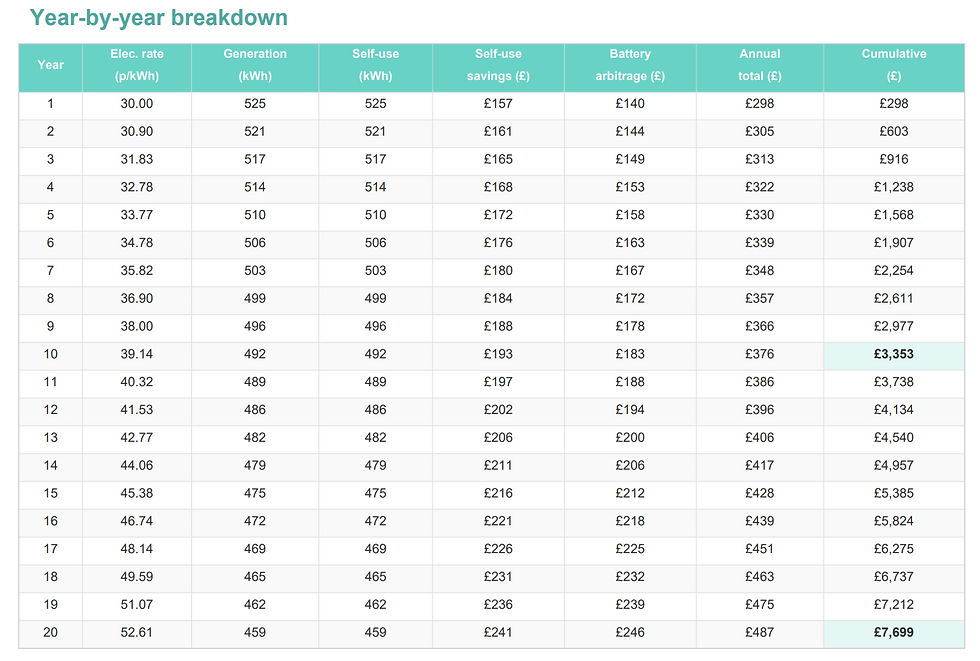
We have modelled the 20-year financial performance of the Storm Plus 710W system (panels + battery) for a typical London household. Here are the assumptions and results.
Assumptions:
The household uses 2,700 kWh per year, which is Ofgem's typical medium consumption figure. The panels are mounted vertically on a south-facing fence or balcony railing in London, which is a conservative estimate. Year 1 generation is 525 kWh. Panel degradation is 2% in year 1 and 0.7% per year thereafter. The electricity tariff starts at 30p/kWh peak and 7p/kWh off-peak, with 3% annual inflation. The battery runs full arbitrage cycles 365 days per year.
Year 1 results:
Solar self-consumption savings: £157. This is the value of the 525 kWh generated by the panels that the household uses directly, avoiding the need to buy that electricity from the grid at 30p/kWh.
Battery arbitrage savings: £140. This is the profit from charging the 1.92 kWh battery at 7p overnight and discharging at 30p during the day, every day for a year. The 87% round-trip efficiency is factored in.
Total Year 1 savings: £298.
20-year results:
Total savings over 20 years: £7,699. This accounts for panel degradation, electricity price inflation at 3% per year, and the battery operating at full capacity throughout.
By Year 10, cumulative savings reach £3,353. By Year 15, they reach £5,385. The system continues generating value well beyond payback.
Payback period:
The Storm 710W kit with battery pays for itself significantly faster than a solar-only system because the battery arbitrage adds £140 per year in savings from day one, independent of solar generation. The exact payback depends on the purchase price of the combined system.
Why battery arbitrage is a game-changer for plug-in solar
Without a battery, a plug-in solar system saves you money only when the sun is shining and you are using electricity at the same time. For a household where everyone is at work or school during the day, much of the solar generation is not used.
With a battery, the economics change completely:
Solar generation is fully captured. The system generates 525 kWh in Year 1, and with self-consumption at 100% (because the output is well below household demand), none of that generation is wasted. Every kilowatt-hour offsets grid electricity at peak rates.
Arbitrage works all year round. Even in December, when solar generation drops to a fraction of summer levels, the battery is still cycling every day, buying cheap overnight electricity and displacing expensive daytime electricity. This is why the battery adds £140 in Year 1 on top of the £157 from solar.
Smart tariffs are getting better. As the UK grid adds more wind and solar capacity, time-of-use tariffs are becoming more common and the spread between off-peak and peak rates is widening. This means battery arbitrage will likely become more profitable over time, not less.
What to look for in a plug-in solar kit with battery
If you are comparing plug-in solar kits with battery storage in the UK, here are the key things to check.
Battery chemistry. Look for LiFePO4 (lithium iron phosphate). It is safer, lasts longer (6,000+ cycles versus 3,000-4,000 for NMC lithium), and handles daily cycling better. The Hoymiles HiBattery uses LiFePO4.
Usable capacity. Some batteries advertise total capacity but the usable capacity is lower. The Hoymiles HiBattery 1920 has 1.92 kWh of usable capacity, which is enough for meaningful daily arbitrage without being oversized for a sub-800W system.
Round-trip efficiency. This is how much energy you get back out versus how much you put in. Higher is better. The Hoymiles HiBattery delivers 87% round-trip efficiency, which means for every 1 kWh you charge, you get 0.87 kWh back.
IP rating. If the battery will be mounted outdoors (near the panels on a balcony or fence), it needs to be weatherproof. IP66 means it is protected against dust and powerful water jets. The Hoymiles HiBattery is IP66 rated.
Warranty and cycle life. A 10-year warranty with 6,000+ cycle life means the battery is designed to last the full economic life of the solar panels. If you cycle it once per day, 6,000 cycles is over 16 years.
Compatibility with your microinverter. Not all batteries work with all microinverters. The Hoymiles HiBattery is designed specifically for the Hoymiles ecosystem, including the HMS-800W-2T microinverter used in Thunder Storm kits. This means seamless integration, single-app monitoring through the Hoymiles S-Miles app, and no compatibility issues.
Can you add a battery to an existing plug-in solar system?
Yes. If you already have a Thunder Storm kit (or any system using a Hoymiles HMS-800W-2T microinverter), you can add the Hoymiles HiBattery as a retrofit. The battery is AC-coupled, so it connects to your home circuit independently. You do not need to modify the existing solar installation.
This means you can start with a solar-only kit now and add the battery later when your budget allows. The solar panels will save you £70 to £140 per year immediately, and adding the battery later will unlock the additional arbitrage savings.
Frequently asked questions
Do I need a battery with plug-in solar?
No. A plug-in solar kit works perfectly well without a battery. You will save money on any electricity you use while the sun is shining. A battery increases your savings by capturing generation you would otherwise miss and by enabling smart tariff arbitrage, but it is not required.
How much extra does a battery add to the cost?
The Hoymiles HiBattery 1920 adds to the upfront cost of the system but delivers approximately £140 per year in additional savings through arbitrage alone, on top of the solar savings. Check out sets for current pricing on the Storm Plus 710W bundle.
Does the battery charge from solar or from the grid?
Both, but they serve different purposes. Solar generation is consumed directly by your household (self-consumption). The battery charges from the grid overnight at cheap off-peak rates and discharges during peak hours. This means the solar and battery savings stack on top of each other rather than competing.
What smart tariffs work with battery arbitrage?
Any time-of-use tariff with a significant difference between off-peak and peak rates. Octopus Go (7.5p off-peak, variable peak), Intelligent Octopus Go, and similar tariffs from other suppliers all work. The larger the spread between off-peak and peak rates, the more you save.
Is the Hoymiles HiBattery safe for indoor use?
The Hoymiles HiBattery uses LiFePO4 chemistry, which is the safest lithium battery technology available. It does not suffer from thermal runaway like NMC batteries. It is IP66 rated for outdoor use but can also be installed indoors in a ventilated space. It produces no noise during operation.
How long does the battery last?
The Hoymiles HiBattery has a 10-year warranty and is rated for 6,000+ charge cycles. At one cycle per day (which is the typical arbitrage pattern), that is over 16 years of operation. LiFePO4 batteries typically retain over 80% of their capacity at the end of their rated cycle life.
Can I monitor the battery remotely?
Yes. The Hoymiles HiBattery integrates with the Hoymiles S-Miles monitoring app, the same app used to monitor the HMS-800W-2T microinverter. You can see battery charge level, charge and discharge rates, daily arbitrage savings, and solar generation all in one place.
Will plug-in solar with a battery power my home during a blackout?
No. The Hoymiles HMS-800W-2T microinverter has anti-islanding protection, which means it shuts down automatically when the grid goes down. During a power cut, neither the panels nor the battery will feed electricity into your home.
Is 1.92 kWh enough battery capacity?
For a plug-in solar system under 800W, 1.92 kWh is well matched. It is enough to run a full daily arbitrage cycle (charge overnight, discharge during the day) and provides meaningful savings without being oversized. Larger batteries are available for full rooftop solar installations, but for a compact plug-in system, 1.92 kWh hits the right balance of cost and return.


Comments